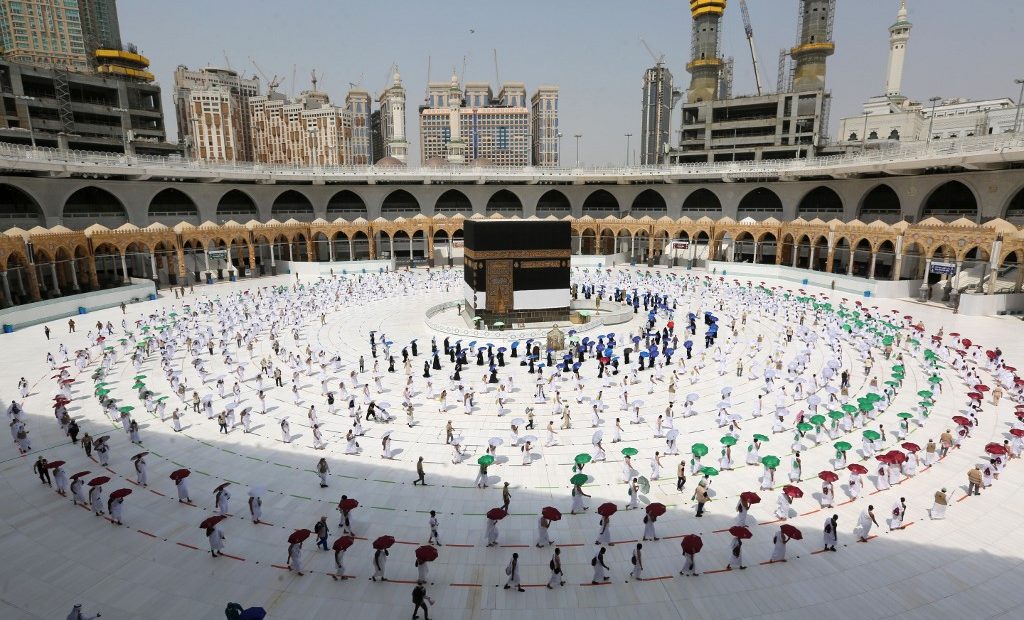
The proceedings of Hajj occurs annually in Dhu Al-Hijjah, the last month of the Islamic calendar which based on Lunar year is 11 days shorter than the Gregorian Calendar. It takes about five days to perform Hajj, starting from 08th of Dhu Al-Hijjah to 12th of Dhu Al-Hijjah.
History of Hajj dates back to as early as the days of Prophet Ibrahim. Prophet Ibrahim left his Son Ismail and wife Hajar with a little food and water to the uninhabited ancient Mecca known as Bakkah back then.
When they went out of supply, Hajar frantically ran seven times between the two hills of Safa and Marwah rummaging for water. However, returning to her baby in despondency, she saw him scratching the ground with his legs soon to discover a water fountain leapt forth beneath his foot.
A few years later in around 2000 BCE, for the commanded of Allah, Prophet Ibrahim constructed the Kaaba and invited people to perform pilgrimage there.
Kaaba is a cubed shaped stone structure, where Muslims gather to strengthen their faith in Allah.
In the era of Jahiliyyah or pre-Islamic Arabia, the Kaaba enclosed with pagan statues. However, in 630 AD, Muhammad (peace be upon him) cleansed the Kaaba by abolishing all the pagan idols and then hallowed it to Allah.
Later in 632 AD, Muhammad performed his only pilgrimage with believers and professed them on the observances of Hajj. It was from this point that Hajj became one of the five pillars of Islam.
In the past century, starting from 1920 to till date, there has been an increment in the number of pilgrims. To commence with more than 50,000 pilgrims attended Hajj in the year 1920 while 3.16 million pilgrims visited by the year 2012.
However, for the first time in decades this year, Hajj was performed with only 1000 pilgrims, including 70% of foreign residents of Saudi Arabia and with the remaining pilgrims being the nationals of Saudi Arabia. All pilgrims selected between are the age of 20 and 50.

 theblankminders